Last updated November 17, 2026








Free written scope consultation - allowances, timeline, and change-order rules on paper before a single trade is scheduled
Bathroom Remodeling Maintenance Schedule: What to Do and When
Silicone caulk at a shower-to-floor transition has a functional lifespan of 3 to 5 years under normal use. Most homeowners don’t replace it until they see a water stain on the ceiling below, and by then a $12 tube of caulk has become a $1,200 repair. A remodeled bathroom runs on a maintenance clock whether you watch it or not. Grout, caulk, sealer, and the exhaust fan all fail on predictable timelines, and in our experience the failures that void workmanship warranties are almost always maintenance items, not installation defects. This guide gives you the actual calendar for a Boulder City bathroom, with the products and intervals that protect the money you spent.
Quick Answer
Maintain a remodeled bathroom on four clocks: inspect at 30, 90, and 365 days after completion, reseal grout every 12 to 24 months depending on type, replace failing caulk every 3 to 5 years in wet zones, and clean the exhaust fan every 6 months while testing its airflow. Everything else, from shower door tracks to fixture cartridges, follows a simple twice-a-year routine that takes under an hour.
Styles & brands we work with
- Kitchen remodeling
- Bathroom remodeling
- Home additions & ADU
- Roofing
- Windows & doors
- Driveway & pavers
- Fence
Table of Contents
- The 30/90/365-Day Post-Remodel Inspection Checklist
- Grout Sealer Schedule by Grout Type
- Caulk Inspection and Replacement Protocol
- Exhaust Fan Maintenance and the Tissue Test
- Shower Door Tracks, Hardware, and the Right Lubricant
- Fixtures, Cartridges, and the Twice-a-Year Walkthrough
- Boulder City Climate and Water: What Changes Here
- Common Mistakes to Avoid
The 30/90/365-Day Post-Remodel Inspection Checklist
A new bathroom moves in its first year. Framing dries, thinset and grout cure, and caulk lines stretch as materials settle at different rates. That’s why the first year matters more than any other, and why we schedule a look at three intervals after every finished project.
At 30 days: Check every caulk line for edge separation, look for hairline cracks in grout at inside corners, and confirm no tile sounds hollow when tapped with a screwdriver handle. Run the shower for ten minutes and watch the floor drain for ponding. Hollow tile or water that sits longer than an hour are callbacks, not settling.
At 90 days: Look at the grout line where the floor meets the wall. Movement there is normal if it’s a hairline; a crack wider than a credit card edge is a defect. Check the toilet base for rocking and the vanity for any gap at the wall seam.
At 365 days: This is the deep inspection. Re-check every caulk joint, test the exhaust fan airflow, look for efflorescence (white mineral powder) on grout, and open the vanity doors to check for swelling at the cabinet bottom near the floor.
What separates settling from a defect: settling is cosmetic and stops. A defect keeps moving. If a crack is wider at 90 days than it was at 30, call the contractor. Bradford’s 365-Day Done Right Promise covers exactly this window on Boulder City projects, because the first year is where workmanship shows itself. For a look at how a full remodel is sequenced before maintenance even starts, see our Bathroom Remodeling in Boulder City page.
Grout Sealer Schedule by Grout Type
Not all grout is sealed the same way or at the same interval. Using the wrong sealer on the wrong grout is one of the most common mistakes we see on callbacks, and it can leave a haze that’s harder to remove than the stain it was supposed to prevent.
Sanded grout (the standard on floors and most shower walls) has visible sand in the mix and joints typically 1/8 inch or wider. It’s porous and needs a penetrating sealer. Apply with a small foam brush or a narrow roller, wipe the tile surface within 10 minutes so it doesn’t cure as a film, and reseal every 12 to 18 months. High-traffic shower floors should be resealed every 12.
Unsanded grout is used on narrow joints (under 1/8 inch) and on polished stone and glass tile where sand would scratch. It’s denser and takes a penetrating sealer every 18 to 24 months. The application method is the same, but coverage is lower because narrow joints take less product.
Epoxy grout is the outlier. It’s essentially waterproof once cured and does not need sealing. If someone tries to sell you a sealer for epoxy grout, that’s the wrong product. Clean it with a pH-neutral cleaner and skip the sealer entirely. If you’re not sure which grout you have, scratch a small spot in an inconclusive corner with a plastic scraper: sanded grout sheds grit, unsanded is smooth, and epoxy feels like hard plastic.
How to know it’s time to reseal: drip a few drops of water on the grout. If it beads and sits, the sealer is holding. If it darkens and soaks in within a minute, reseal. That water-drop test works on every grout type and takes less time than reading this paragraph.
Caulk Inspection and Replacement Protocol
Caulk is the first line of defense in any wet area and the first thing to fail. Silicone at the shower floor, tub deck, and vanity backsplash has a working life of 3 to 5 years. In our experience, the difference between a homeowner who catches a failure in year three and one who catches it in year six is usually a ceiling repair and a subfloor repair.
Signs a caulk line is failing before it leaks:
- Surface crazing: fine cracks across the surface like dried mud. It’s on its way out.
- Edge separation: a visible gap or shadow where caulk meets tile or tub. Water is already getting behind it.
- Discoloration that won’t scrub out: dark streaks inside the caulk body, not on top, usually mean mold has reached the adhesive layer.
- Spongy feel: press gently with a fingernail. If it dents and stays dented, the caulk has broken down.
Replacement steps:
- Cut out the old caulk with a plastic caulk-removal tool or a utility knife with a fresh blade. Never dig at the substrate. A metal scraper on fiberglass or acrylic scratches permanently.
- Clean the joint with isopropyl alcohol and let it dry fully, at least an hour.
- Use a 100% silicone sealant rated for wet areas and approved for the substrate (some silicones don’t bond to acrylic tubs; read the tube). Mask both sides with painter’s tape for a clean edge.
- Tool the bead with a wet finger or silicone tool in one pass. Pull the tape while the caulk is still wet.
- Don’t run water on the joint for 24 hours.
Every bathroom we finish in Boulder City gets this same spec, and we put the post-completion care in writing along with the price. The sequence we follow from demolition to final caulk is on our General Contractor in Boulder City page.
Exhaust Fan Maintenance and the Tissue Test
The exhaust fan is the most neglected piece of a remodeled bathroom and the one that quietly causes the most damage. It pulls moisture out before it condenses on walls, mirrors, and framing. When airflow drops, that moisture goes onto the surfaces instead, and over a year you get peeling paint and mold at the ceiling corners.
Clean the housing every 6 months:
- Kill power at the breaker.
- Pull the grille off (most snap out with two spring clips).
- Wash the grille in the sink with dish soap and warm water.
- Vacuum the blower wheel with a soft brush attachment; a stiff brush bends the blades and hurts performance.
- Wipe the housing interior with a damp cloth.
- Reassemble and restore power.
The tissue test: hold a single-ply tissue to the grille while the fan runs. On a good fan it pins flat against the grille. If it flaps or falls, airflow is low. Compare against a new bathroom fan if you have one in the house. The key distinction: dust buildup recovers after cleaning, motor wear doesn’t. If airflow is still weak after a cleaning, the wheel or motor is worn and the fan is due for replacement, usually every 8 to 10 years.
Bath fans here run more than most because of the dry climate and constant cooling. A live-person call to Bradford at (844) 797-9259 gets you a straight answer on whether the fan is a maintenance item or a replacement item before you pull it apart.
Shower Door Tracks, Hardware, and the Right Lubricant
Shower door tracks and hinges are where silicone gaskets live, and the wrong lubricant eats those gaskets. WD-40 is the common go-to and the wrong call for a wet-area shower door. Its solvent base and light oil film degrade silicone over time, and once a gasket swells or softens, the door starts to drag, then leaks.
Use instead: a silicone-based grease (available by the tube, made for plumbing and door tracks) or a dry PTFE spray. Apply a light film on rollers and hinges every 6 months. For track channels, clean first, then a very thin coat.
Twice-a-year track routine:
- Wipe the track with a 50/50 white vinegar and water mix and a soft brush. Mineral deposits from Boulder City’s hard water lock up rollers faster than dust.
- Check the bottom track weep holes are clear; blocked holes pool water on the curb and start the rot.
- Test the door swing. A door that catches the stop or jumps the track is a roller or hinge issue, not a glass issue.
- Check the seals at the door edges and bottom sweep for hardening. Replace sweeps every 2 to 3 years.
Kohler, Moen, and Delta shower systems all publish their own recommended care here, and if you’re replacing a cartridge or door hardware, matching the brand’s spec is cheaper than replacing the whole door.
Fixtures, Cartridges, and the Twice-a-Year Walkthrough
Beyond the big items, a remodeled bathroom needs a twice-a-year walk-through (spring and fall work well) to catch the small things before they become callbacks.
Faucet cartridges last 8 to 12 years on most name-brand fixtures before they start dripping. Drip is your cue; replace the cartridge, not the whole faucet. A Kohler or Moen cartridge is cheap and usually a 20-minute job.
Toilet flappers last 3 to 5 years. If you hear the tank refilling itself in the middle of the night, the flapper is leaking and you’re paying for water.
Vanity cabinet bottoms can swell if a slow leak goes unnoticed. Open the doors and feel the floor of the cabinet once a year; soft spots mean a leak from above.
Mirrors, exhaust grilles, and light fixtures collect dust in a damp room faster than elsewhere in the house. Wipe down every 6 months.
The full scope of what’s involved in a bathroom build before maintenance begins (framing, rough-in, tile, and finishes) is covered on our Bradford Remodeling Boulder City home page, and the broader whole-home picture from our Kitchen Remodeling in Boulder City page applies to the same care rhythms.
Boulder City Climate and Water: What Changes Here
Boulder City is a dry, high-desert climate, and that shapes a maintenance schedule in two specific ways.
Hard water, high mineral content. The water here leaves calcium deposits on glass, grout, and shower tracks faster than most of the country. That means shower doors need cleaning every two weeks, not monthly, and grout in a shower needs sealing on the shorter end of every range: 12 months for sanded, 18 for unsanded. Vinegar-and-water cleaning every two weeks is cheaper than a glass replacement.
Low humidity and a strong summer sun. The dry air dries caulk faster in the off-season and can lead to more frequent shrinkage at the shower-to-floor joint, especially on the west- and south-facing bathrooms in Boulder City. We recommend checking that joint every 6 months rather than annually.
Winter temperature swings in Boulder City aren’t extreme, but a bathroom on an exterior wall can see a 30-degree swing through a day. That’s a small movement cycle that shows up as hairline cracks at the inside corners of tile, which is normal but worth watching at the 90-day inspection. If those cracks grow, that’s a framing or waterproofing call, not a caulk call.
The other local factor: a lot of Boulder City homes run on septic, and a bathroom remodel that adds fixtures can matter to the system. Confirm the number of fixtures before adding a second sink or a second shower valve.
Common Mistakes to Avoid
- Sealing epoxy grout. It’s already non-porous. Sealer sits on the surface and hazes. If a bathroom has epoxy grout and someone recommends sealing, they haven’t looked at the grout type.
- Using WD-40 on shower door tracks. It degrades silicone gaskets and turns a $20 roller replacement into a $300 door rebuild.
- Ignoring the 30-day inspection. In our experience, most Boulder City callbacks we wish we’d caught early were visible at 30 days, not 9 months. We can fix a hairline crack in the first month far more easily than a water stain in the last.
- Skipping the exhaust fan cleaning. A fan that runs but can’t move air is worse than a fan you turn off, because the running motor heat discourages the drying you’d otherwise get. Clean it at 6 months, every time.
- Resealing over old sealer. Sealer has to be fully stripped before reapplying. Layering traps moisture underneath and makes it look like mold that won’t clean off.
- Caulking over failing caulk. New caulk won’t bond to old. Cut it out; never lay a bead on top. That’s how water gets behind both.
- Scrubbing grout with bleach. It reacts with the minerals in this water and can leave a permanent film. Use a pH-neutral cleaner, not a bleach spray.
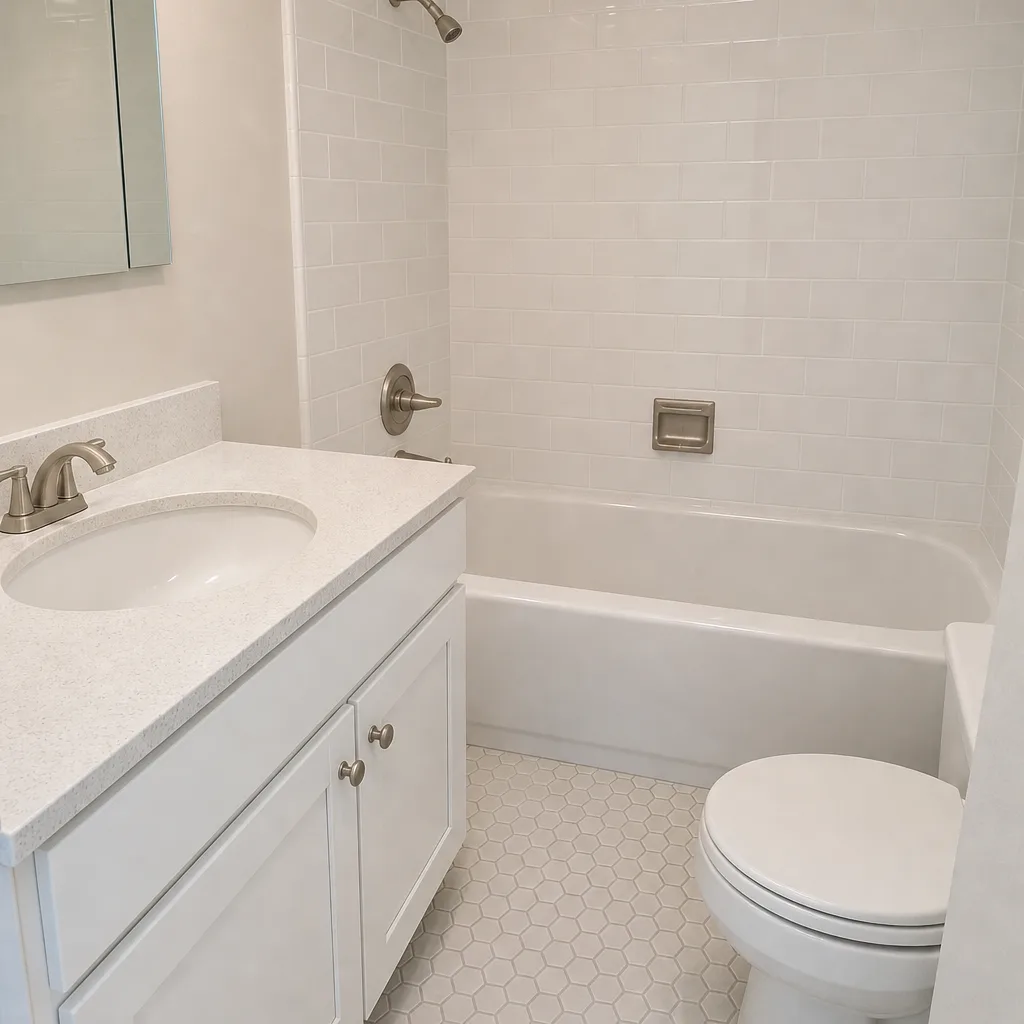
See the difference
 Before
 After
 Before
 After
 Before
 After
When to Call a Professional
Most of this schedule is homeowner work. Call a professional when the problem is structural or behind the tile: a grout crack that widens between inspections, a hollow tile that sounds hollow underfoot, water stains on the ceiling below (the cheapest fix is at the failure point, not the ceiling), or a shower pan that holds water longer than an hour. Exhaust fan motor wear past cleaning, a shower door that won’t close flat, and any movement in the floor around the toilet warrant a look too. Bradford Remodeling Boulder City offers free estimates in Boulder City – call (844) 797-9259 and a live person will answer, not a queue. Every estimate comes as a written price before anything starts and a 365-Day Done Right Promise on the finished work.
Frequently Asked Questions
Every 12 to 18 months for sanded grout and 18 to 24 months for unsanded. Epoxy grout doesn’t need sealing at all. Use the water-drop test: if water beads on the grout, it’s protected; if it soaks in, it’s time to reseal.
No, and you don’t need to. Caulk in a wet area lasts 3 to 5 years under normal use. Check it every 6 months, and replace it when you see crazing or edge separation. In Boulder City, the drier air can shorten that on a sunny-facing wall, so do the 6-month check rather than once a year.
Use pH-neutral cleaner on grout, glass, and stone. Vinegar and water is fine for glass and shower doors, and diluted on some grouts. Avoid bleach-based sprays on grout; they can leave a permanent film with the local water’s mineral content.
Every completed Bradford bathroom carries a written guarantee for a full year; if the work fails inside that window, we come back and correct it at no charge. The guarantee is in your hand at job close with the documented scope, so you know exactly what’s covered and for how long.
Do the tissue test: a single-ply tissue should pin flat to the grille while the fan runs. If it flaps or falls after you’ve cleaned the housing and blower, the motor is worn and the fan needs replacing, usually around 8 to 10 years old.
In our market, a full bathroom remodel typically ranges from $18,000 to $45,000 depending on size and finish level, with a half-bath running lower. Every Bradford estimate is a written price before work starts, with no numbers that move at the door. Call (844) 797-9259 for a free estimate.
The Bottom Line
A remodeled bathroom has a clock running from day one. The three items that matter most: inspect at 30, 90, and 365 days; reseal grout on the correct schedule for its type (12 to 18 months for sanded, 18 to 24 for unsanded, never for epoxy); and replace failing caulk before it leaks, not after. Clean the exhaust fan every 6 months and use silicone grease, never WD-40, on shower door hardware. In Boulder City, hard water and a dry climate shorten the grout and caulk intervals slightly. Keep the schedule and the workmanship guarantee stays intact. Skip it and the failures look like defects but aren’t.
For a free estimate on a bathroom remodel in Boulder City or to have a technician look at a maintenance issue before it becomes a repair, call Bradford Remodeling Boulder City at (844) 797-9259. A live person answers 24/7, every price is in writing before work starts, and every finished project carries the 365-Day Done Right Promise.
Written by the team at Bradford Remodeling Boulder City.