
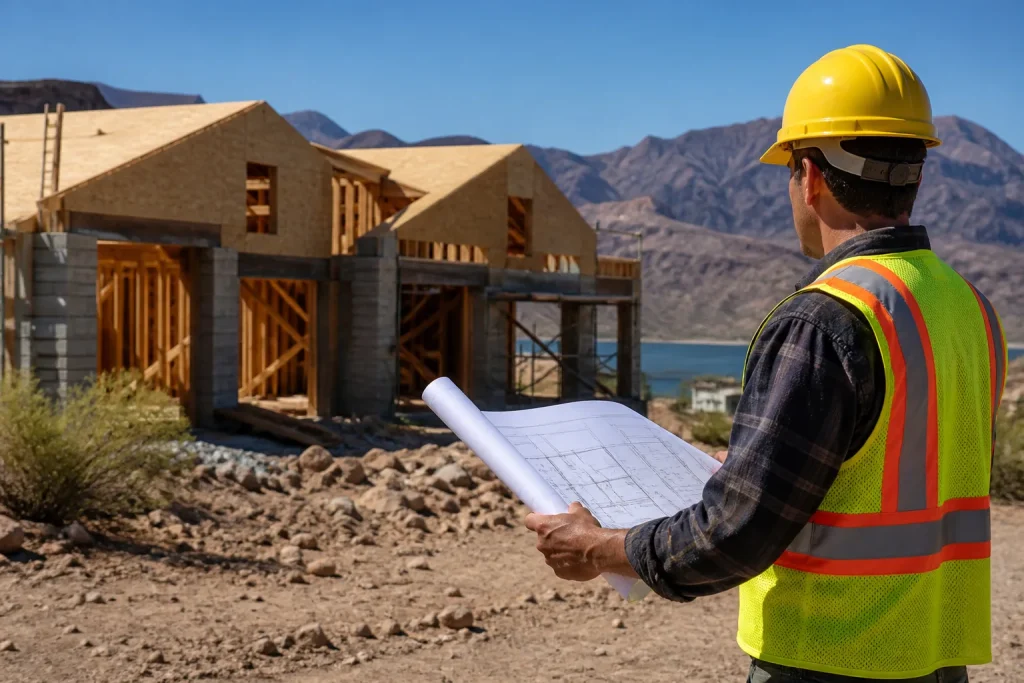

Top Signs You Need Construction Service – Don’t Ignore These
A hairline crack in drywall and a stair-step crack in a CMU block wall can look almost identical to an untrained eye. One is settling cosmetics. The other points to foundation movement or a lateral load problem that costs more every season it goes uninspected. The real issue is vocabulary: most homeowners can’t tell cosmetic wear from structural wear, and the signs you need construction service in Boulder City sit right on that dividing line. This guide gives you the words and the visual tells to know which one you’re looking at.
If reading this makes you want a trained set of eyes on the house, call (844) 797-9259 for a free estimate. But read first. You’ll get more out of that call when you already know what you’re seeing.
Key Takeaways
- Crack pattern matters more than crack size. A wide vertical crack can be cosmetic; a thin stair-step crack in block can be structural.
- In Boulder City, stucco over concrete block is the standard wall system, and it fails differently than wood-frame walls elsewhere.
- In a low-rainfall desert, moisture damage almost always traces to one of a few water paths, not to rain volume.
- High-UV exposure ages roofs, flashing, and fascia 1 to 2 seasons ahead of interior symptoms. That gap is your warning window.
- Flickering under load and multiple slow drains at once are licensed-contractor signals, not handyman signals.
- Photograph and measure before you call, so your first conversation is about scope and price instead of a diagnostic visit.
What do cracks in Boulder City block and stucco walls actually mean?
Crack pattern tells you what the wall is doing. Size alone tells you very little. In Boulder City’s concrete masonry unit (CMU) construction – block walls skim-coated in stucco’s predecessors and finished stucco – the walls are rigid. They don’t flex like wood frame. So when the ground beneath moves, the wall expresses that movement as a crack pattern rather than a sag.
Here’s how to read them:
- Stair-step cracks that follow the mortar joints diagonally, often from a corner of a window or door opening. This is the classic sign of differential foundation settlement or lateral soil pressure. It’s the one we’d want eyes on this week, not next spring.
- Horizontal cracks in a block wall, especially near the base or mid-height. This suggests the wall is being pushed inward, usually by soil pressure or an unbraced retaining situation. Horizontal cracks in block are rarely cosmetic.
- Vertical cracks with displacement – the two sides aren’t in the same plane when you run a straightedge or a coin edge across them. Displacement means the wall has actually shifted, not just shrunk.
- Fine vertical or map cracks in stucco, especially the spiderweb pattern on a broad south or west face. These are usually thermal expansion and normal stucco curing. Boulder City swings hard between afternoon heat and cool desert nights, and stucco moves with it.
The rule we use on the job: pattern plus displacement. Stair-step or horizontal, or any crack where the edges don’t line up, gets a professional look. Wide-spaced map cracking in stucco with no displacement gets monitored with a pencil mark and a date. Write the date on the wall next to the crack. Check it after a season. If it has grown past the point of a business card edge, it’s time to stop watching.
What moisture signs get dismissed in a desert climate?
Homeowners in Boulder City reasonably assume that with single-digit annual rainfall, water isn’t the problem. But desert moisture damage almost never comes from how much rain falls. It comes from where the small amount that falls goes, how long it sits, and what path it takes through the wall. The signs are specific and most people walk right past them.
- Efflorescence. That chalky white bloom on a block or stucco wall is salt pushed to the surface by water moving through the masonry. It’s not just mineral staining to scrub off. If it keeps coming back after you clean it, water is still traveling through the wall from somewhere, often a failed roof flashing detail or a planter bed piled too high against the wall.
- Rust streaking from rebar. Orange-brown vertical staining on a block or stucco face usually means the steel reinforcement inside has gotten wet and started to corrode. That’s a structural warning, not a cosmetic one. Corroding rebar expands and eventually spalls the face of the wall off.
- Efflorescence or dark staining at the base of an interior wall near a bathroom or the kitchen. That often traces to a rough-in leak, meaning the plumbing inside the wall rather than the roof above.
In our experience, the worst one we see is a sprinkler head or drip line parked against a block wall for years. The wall stays saturated in a climate that never expects it, and the block face begins to fail quietly. If you see efflorescence reappearing or rust streaks anywhere on a Boulder City block wall, that’s your signal to call a licensed contractor to trace the water path, not to repaint over it.
How can the desert climate harm your roof and fascia without a leak?
High UV exposure ages exterior components faster than anything else around the home. In Boulder City, we get a sun load that bakes the roof deck, flashing, and fascia boards, and the failure pattern shows up on the outside 1 to 2 seasons before you ever see a stain on the interior ceiling. That gap is your warning window, and it’s a gift if you use it.
What to look for from the ground, with binoculars if you have them:
- Lifted or curling flashing around chimneys, vents, and roof-to-wall transitions. Flashing that has pulled away from the surface lets wind-driven rain in sideways, which a shingle roof is not built to shed.
- Granule loss patterns on the shingles. Bald patches on south and west slopes are UV wear. If the granules are collecting in the gutters and the surface starts to look like asphalt felt, the shingles are near end of life.
- Soffit and fascia deterioration. The soffit is the underside panel of the roof overhang. When it starts to delaminate, sag, or show peeling paint, you’re looking at sun damage that lets heat and moisture into the attic cavity. Fascia (the trim board along the roof edge) that feels soft or chalky means the paint barrier is gone.
If you’re replacing soffit or fascia, the material matters. We install James Hardie fiber cement and Therma-Tru exterior products because the manufacturer publishes a spec sheet and a warranty that we can hand to you and stand behind with our own. Soffit failure that has already happened in two spots on a Boulder City home is usually the point to have the whole run looked at, not just the split piece.
Which electrical and plumbing signals need a licensed contractor?

Some repairs are genuinely tile-and-plug work for a handyman. Others are not. The electrical and plumbing signals below cross the line into licensed-contractor territory because they point to something inside the wiring or the plumbing rough-in (the pipes and wires inside the wall), and that work requires an inspection and a permit.
Electrical:
- Flickering lights when you turn something else on – the furnace, a space heater, a pump. That’s a load problem, not a bulb problem. It can indicate a loose neutral or an undersized circuit, and it’s a fire risk worth a licensed electrician.
- Breakers that trip repeatedly on the same circuit without a new load added.
- Faint burning smell or warm switch plates – stop using the circuit and call.
Plumbing:
- Multiple slow drains at once – the kitchen sink and the tub both draining slowly at the same time points to a shared line or the main, not a clogged trap. A single slow drain is a clog. Simultaneous slow drains are a drainage system issue.
- Water heater age and anode rod status. The anode rod is the sacrificial metal inside the tank that corrodes so the tank doesn’t. If a water heater is older and nobody has ever checked or swapped the rod, tank failure is a matter of time, and the first sign is often a puddle in the laundry room.
We can’t overstate this: electrical panel work, gas lines, and high-tension systems are not DIY territory, and a handyman can’t legally pull those permits. If you’re seeing any of the signals above in a Boulder City home, call a licensed contractor to inspect. We can bring a qualified technician out and give you a written scope before anything moves.
How do you document the signs before you call?
This is the part that saves you money and keeps your first conversation with a contractor short. A diagnostic visit that starts with “something’s wrong, I don’t know what” turns into an open-ended estimate. A visit that starts with a binder of photos and measurements is a scope conversation. Here’s the folder to build.
- Photograph every crack with scale. Tape a coin against the wall next to the crack and shoot it straight on. A 5-cent piece or quarter gives anyone reading the photo a size reference.
- Photograph the pattern, not just the crack. Frame the whole wall, then get close. Pattern is the diagnostic detail – stair-step versus map cracking reads instantly in a wide shot.
- Mark cracks with a pencil and a date. Note the width by writing it on the drywall or stucco right next to the mark. Check it every month or two and note any growth.
- Photograph water damage from above and below. Ceiling stain, then attic side of the same spot if you have access. That tells the contractor whether the water is tracking from a roof point or coming in laterally.
- Write down the timeline. When did you first notice it, what’s the weather been, was there a storm. A contractor can use this to cross-check against a known weather event in Boulder City.
- Photograph the electrical panel label and the water heater data plate. Age and capacity are two facts that send the estimate in different directions.
When you’re ready, ask for a written price before any work starts. At Bradford Remodeling Boulder City, that’s not a special request – it’s The Garrison Standard. Every project gets a written price up front and a signed 365-Day Done Right Promise at close, which means if the work fails inside a full year, we come back and correct it at no charge. If a crew is hesitant to put the number in writing before they start, that’s its own sign.
The Bottom Line

Cracks are a language. Learn the pattern: stair-step and horizontal in block means structural movement, fine map cracking in stucco is usually thermal. Learn the moisture tells: efflorescence that returns and rust streaks from rebar mean water is still moving through the wall. Learn the roof gap: lifted flashing and soffit failure show up 1 to 2 seasons before the interior stains do. And learn the licensed-contractor signals: flickering under load, simultaneous slow drains, and an aging water heater with no anode maintenance. Document it yourself with photos, scale, and dates so your first conversation is about scope and price. If you’re in Boulder City and need a trained set of eyes, Bradford Remodeling Boulder City offers free estimates – call (844) 797-9259.
Related services in Boulder City: if the signs above point to a bigger scope than a repair, our General Contractor in Boulder City team handles the whole job, from Kitchen Remodeling in Boulder City to Bathroom Remodeling in Boulder City. You can also start at the Bradford Remodeling Boulder City home page to see how we work.
Frequently Asked Questions
Pattern and displacement, not size. A wide vertical or spiderweb crack in stucco with the two edges in the same plane is usually thermal or curing. A stair-step crack following mortar joints, a horizontal crack in a block wall, or any crack where the edges are offset is a structural sign, and it warrants a licensed contractor on-site. Call (844) 797-9259 for a free estimate and we’ll give you a written scope.
It can be, yes. Efflorescence is salt pushed to the surface by water moving through the masonry, so if it keeps returning after cleaning, water is still traveling through the wall and the source needs to be found. In Boulder City the source is often a flashing detail or irrigation parked against the wall. Call (844) 797-9259 and we’ll trace it before it spreads.
Anything involving the electrical panel, wiring, gas lines, or plumbing inside the wall needs a licensed contractor who can pull permits and pass inspection. Handymen are fine for quiet cosmetic fixes. If your signs are flickering lights under load, simultaneous slow drains, rust off the rebar, or a stair-step crack, that’s licensed-contractor work. Call (844) 797-9259 for a free estimate.
Not at Bradford Remodeling Boulder City. You get a written price before any work begins, and it doesn’t move at the door. Every completed project is also covered by the 365-Day Done Right Promise – if the work fails inside that full year, we come back and correct it at no charge. Call (844) 797-9259 to schedule your free estimate.
Written by the team at Bradford Remodeling Boulder City.
Need Construction Help?
Call Bradford Remodeling Boulder City - licensed & insured, here with fast after-hours help in Boulder City.
(844) 797-9259