Last updated November 17, 2026






Free written scope consultation - allowances, timeline, and change-order rules on paper before a single trade is scheduled
Bathroom Remodeling Warning Signs Every Homeowner Should Know
A contractor who quotes a bathroom remodel without asking about your existing plumbing configuration, ventilation setup, or subfloor material either isn’t planning to look at them, or is planning to bill you for them later as “unforeseen conditions.” That single behavior, more than any other, separates a contractor who is squaring a job away from one who is winging it. In this guide we’ll walk through the specific documents, questions, and answers that expose a weak bathroom contractor before the contract is signed: the pre-quote inspection standard, the written scope test, license verification, subcontractor disclosure, and payment schedules. We’ll write it from Boulder City, where we’ve watched these failures repeat.
Quick Answer
To avoid a bad bathroom remodeling contractor, request four things before signing: a written scope that names the waterproofing membrane, backer board, thinset, and grout products; a verified Nevada contractor license checked on the NSCB site; the names of the licensed plumber and electrician who will do the rough-in work; and a payment schedule where the deposit is no more than 10% and milestones are tied to specific completed phases. A contractor who can’t or won’t provide all four is a warning sign you should take seriously.
Styles & brands we work with
- Kitchen remodeling
- Bathroom remodeling
- Home additions & ADU
- Roofing
- Windows & doors
- Driveway & pavers
- Fence
Table of Contents
- The Pre-Quote Site Assessment Standard
- The Written Scope Specificity Test
- Nevada Contractor License Verification
- The Subcontractor Disclosure Question
- Payment Schedule Red Flags
- Written Completion Dates and Schedule Discipline
- Boulder City-Specific Challenges
- What “Squared Away” Looks Like at Job Close
The Pre-Quote Site Assessment Standard
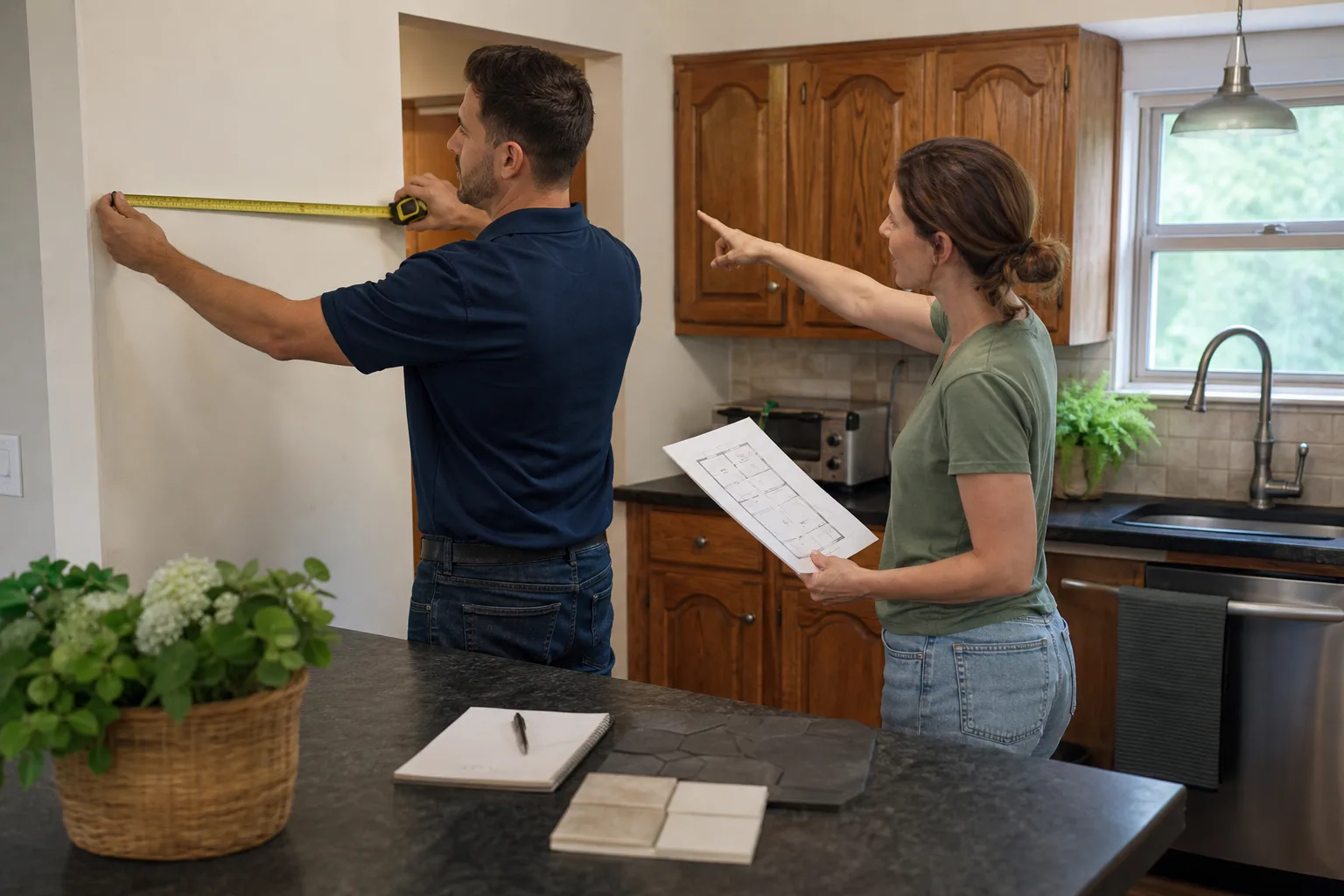
A bathroom quote should be written on a clipboard in your bathroom, not at a kitchen table with a calculator app. A thorough contractor physically inspects five things before assigning a number, and if any of them are missing from the conversation, you’re looking at a drive-by quote. That’s the first and most reliable warning sign.
Here’s the inspection standard to hold a contractor to:
- Subfloor condition. They need to see whether the existing subfloor is plywood or OSB, check for soft spots, and measure whether it’s thick enough to support tile. A tile floor over a flexible or water-damaged subfloor will crack within a year.
- Existing drain and supply locations. Every drain move is a cost item. A contractor who doesn’t ask about slab versus raised foundation (Boulder City has both, especially in older blocks near the historic district) has no way to price a shower relocation.
- Exhaust fan ducting path. Where does the bath fan terminate? Through the roof, through a gable wall, or dumping straight into the attic? That last one is a moisture problem waiting to happen, and correcting it is real money.
- Wall cavity depth. This determines whether a recessed medicine cabinet or a shower niche fits, and it dictates how tile transitions to drywall at the perimeter.
- Existing shut-off valves and electrical load. A dedicated circuit for the bathroom is often required when you add a heated floor, a bidet seat, or a larger fan. If the panel is full, that’s an added cost they need to see now.
If you get a bathroom number over the phone, or after a fifteen-minute walkthrough that skips all five of these, treat it as a placeholder. The real price will materialize after demolition, and the change order will land in your inbox. Our team treats the pre-quote visit as the whole job: nothing gets priced until it’s been seen.
The Written Scope Specificity Test
Take out a red pen and read the written scope line by line. If the tile line reads “tile labor and materials,” the scope is a hazard. A compliant bathroom scope names the specific products that determine whether the room stays dry for decades, because those products are exactly where corners get cut.
A scope that passes the test will name:
- The waterproofing membrane system by brand and product (a bonded sheet membrane, a liquid-applied coating, or a foam board system, specified by name).
- The backer board type – cement board, foam board, or a gypsum-based substrate – with thickness.
- The tile setting method, including thinset specification (modified or unmodified, ANSI classification, notched trowel size).
- The grout product by brand, and whether it’s cementitious or a single-component grout.
If the scope says “install waterproofing per code,” ask them to fill in the blank. A contractor who can name the membrane system from memory has done this job a hundred times. A contractor who can’t probably hasn’t.
We specify name-brand fixtures and substrates from a documented roster: Kohler and Moen for fixtures, Cambria and Caesarstone for surfaces when a vanity goes in, and Sterling shower bases and surrounds when a full-height tub-to-shower conversion makes sense. Sterling material specs and warranties are traceable, which means every warranty is backed by the manufacturer in writing – not just a handshake. And when the exhaust fan duct terminates through the roof, we specify GAF roofing accessories to make the penetration weather-tight, because a leak at the vent boot is the most common roof leak we see on bathroom work.
The same test applies to fixtures. “Plumbing fixtures: included” is not a scope. A compliant line names the faucet brand, trim finish, valve type, and manufacturer – saying “Grohe thermostatic valve and trim” is a scope; saying “shower faucet” is a wish.
Nevada Contractor License Verification
Nevada licenses residential remodeling contractors through the Nevada State Contractors Board (NSCB). Verifying a license is free, fast, and takes about five minutes if you know what to look at. Doing it is the single highest-leverage thing you can do before signing a bathroom contract in Boulder City.
Here’s the step-by-step:
- Go to the NSCB license search at nscb.nv.gov and search by the company’s legal name and license number.
- Confirm the license is “active” and “in good standing.” A suspended license is a dealbreaker.
- Check the classification. For residential bathroom remodels, you want a Class B (general building) or Class A (general engineering) with residential endorsement, or a specialty license that covers the specific trade.
- Check the bond amount. Nevada sets minimum bond values per classification, and a low bond limits your recourse if a job goes sideways.
- Look for disciplinary actions. The NSCB posts final orders. One resolved complaint doesn’t sink a contractor; a pattern of consumer-protection violations should.
- Confirm the general liability insurance certificate directly from the carrier – call the number on the certificate, don’t just take the PDF.
Every contractor performing work in Boulder City must carry an active Nevada contractor license – this is not optional and the NSCB enforces it. If a contractor can’t produce a license number immediately, you’re looking at unlicensed work, and that means no bond claim, no board complaint, and no recourse if the job fails.
Ask for the license number in writing and match it against the certificate of insurance and the written contract. Three matching documents, one contractor. That’s the Garrison Standard in practice: the paperwork is the contract.
The Subcontractor Disclosure Question
A general contractor rarely does the plumbing and wiring in a bathroom remodel themselves. In Nevada, plumbing and electrical work must be performed by a separately licensed trade contractor, and the person swinging the hammer and the person setting the valve are almost never the same. That is normal and legal – but the GC should know who those people are, and they should give you the names before you sign.
Ask two questions, and write the answers into the contract:
- Who is the licensed plumber carrying the rough-in work? Get the company name, license number, and the trade license classification.
- Who is the licensed electrician handling the fan, GFCI, and any added circuits? Same detail.
Why this matters: in a bathroom, the plumbing rough-in is a fixed cost you cannot easily change once walls close. If a GC won’t disclose the plumber’s name, the plumbing line on your quote is probably a placeholder that will be adjusted at the door. In Boulder City, we’ve seen this play out in older brick homes near the historic district where the waste line runs through a masonry wall; a plumber who hasn’t been on-site to inspect will not know how to price that, and the difference is hundreds of dollars.
If the GC is cagey about sub names – “we have a guy,” “we handle all of that” – push back. The names are a matter of record with the NSCB, and any licensed contractor can retrieve them. Refusal is a warning sign with no good explanation.
Payment Schedule Red Flags
Payment structure tells you how the contractor thinks about money, and the schedule is where most bathroom disasters are set up months before the first tile is laid. Three signals matter most.
Front-loaded deposits. More than 10% down before materials are delivered is a red flag. That deposit covers the initial site protection and demo mobilization; it doesn’t cover a new tile shower. A schedule that asks for 30% or 50% upfront is either undercapitalized or predatory. Neither is safe.
Lump-sum milestones. Instead of “50% at completion,” the schedule should read “20% at rough-in inspection passed,” “30% at tile complete,” and “final payment at punch-list walk.” Each milestone should be tied to a specific completed phase that you can verify with your own eyes and, ideally, an inspector’s signature.
No written completion date. If the contract has no agreed completion date, there is nothing to hold a contractor to. Every project we run puts a written completion date in the contract and a schedule commitment with it – not a “sometime in the next few weeks” verbal promise.
Here’s what a clean payment schedule looks like for a typical bathroom remodel in Boulder City:
- 10% at signing (mobilization and site protection)
- 25% at removal and framing complete (verified)
- 30% at rough-in plumbing and electrical inspection passed
- 25% at tile and waterproofing complete with flood test documented
- 10% at final punch list signed
Ask the contractor to walk you through their schedule in those terms. If they can’t, or the numbers look aggressive, ask why. They will tell you more about their process in that conversation than in any three references.
Written Completion Dates and Schedule Discipline
A verbal timeline isn’t a timeline. “About four to six weeks” is a range, not a commitment, and it gives a contractor no reason to keep the crew moving. Ask for the start date, the number of working days to substantial completion, and the penalty or remedy language if that date slips beyond the agreed buffer.
That’s not aggressive. It’s how a disciplined contractor runs anyway. We plan bathroom work in phases – demo and rough-in, inspection, waterproofing and tile, trim and fixtures, punch – and put the phase dates in the contract. When something on-site changes, the change comes in writing before the date moves.
A seven-week bathroom remodel that slips to twelve weeks almost always comes from a contractor who left the schedule verbal and the crew unmanaged. If the plan stays in their head, it slips to a place you can’t see until you’re sleeping on a pull-out sofa.
Boulder City-Specific Challenges
Boulder City has a housing stock that stresses bathroom remodels in ways you won’t read about in a national contractor guide. Three specific patterns show up here again and again:
Older brick construction and masonry waste walls. Some of the older homes near the historic district run waste plumbing through exterior brick walls, which means any drain relocation is a masonry job, not just a plumbing job. A contractor who quotes a shower-to-tub conversion without seeing that wall is going to hit it in week two.
Chase-outs and panel limits. Many Boulder City garages were wired decades ago, and adding a heated floor, a bidet seat, or a second bath circuit often requires a subpanel upgrade. If a contractor doesn’t look at the panel before quoting, the number excludes that upgrade – and that upgrade is hundreds of dollars.
Dry heat and long summer sun. Boulder City’s dry heat cracks grout lines and shrinks caulk joints if the wrong product is specified. A standard cementitious grout with no modified additive will fail faster here than in a humid climate. Ask specifically which grout product is being specified and whether it’s rated for high thermal movement. That’s a Boulder City question, not a general one, and it separates contractors who know the local market from those who don’t.
If you’re also planning work beyond the bathroom, the same discipline applies across the rest of the home. Our Bradford Remodeling Boulder City home page covers how the broader scope fits together, and the General Contractor in Boulder City page walks through how we run whole-house projects.
What “Squared Away” Looks Like at Job Close
A clean job close is the final test. When the bathroom is finished, you should have three things in hand: a clean site (no debris, no paint drips on the tile floor), a documented scope with signed change orders behind you, and a signed written guarantee.
Our 365-Day Done Right Promise is exactly that. Every completed project carries a full-year written guarantee: if the work fails inside that window – a shower pan leak, a grout line that opens, a fixture that doesn’t hold – we come back and correct it at no charge. That guarantee is one page, and you get it before we send the crew home.
Common Mistakes to Avoid
- Signing with a contractor who hasn’t been on-site for at least an hour. A bathroom number without a real inspection is either high or low, not an estimate. In Boulder City’s older brick stock, the physical walkthrough is everything.
- Accepting “tile labor and materials” as a scope line. It’s the most expensive line item on the job, and it hides the membrane system, backer board, thinset, and grout – the four products that decide whether your new shower holds water.
- Trusting a license number you didn’t verify on the NSCB site. Contractors occasionally borrow a number from a family member or subcontractor. Ask for the certificate and match it. Then call the insurance carrier directly.
- Paying more than 10% before materials are delivered. Front-loaded schedules are the most common failure pattern in bathroom work. If the deposit is higher, ask in writing where the money goes and request receipt proof per draw.
- Letting the plumber and electrician go unnamed. In a bathroom, those two trades do the highest-stakes work and the highest-dollar work. Unnamed subs on the contract are unnamed subs on site.
- Leaving the completion date verbal. A “roughly four to six weeks” timeline is not a schedule. A written date in the contract is. Every week the timeline slips, the drywall patching cost rises.
- Skipping the waterproofing flood test. Ask the contractor to document the shower pan flood test before tile goes in. Insist on a photo. If they won’t do it, they’ve never done it.
See the difference
 Before
 After
 Before
 After
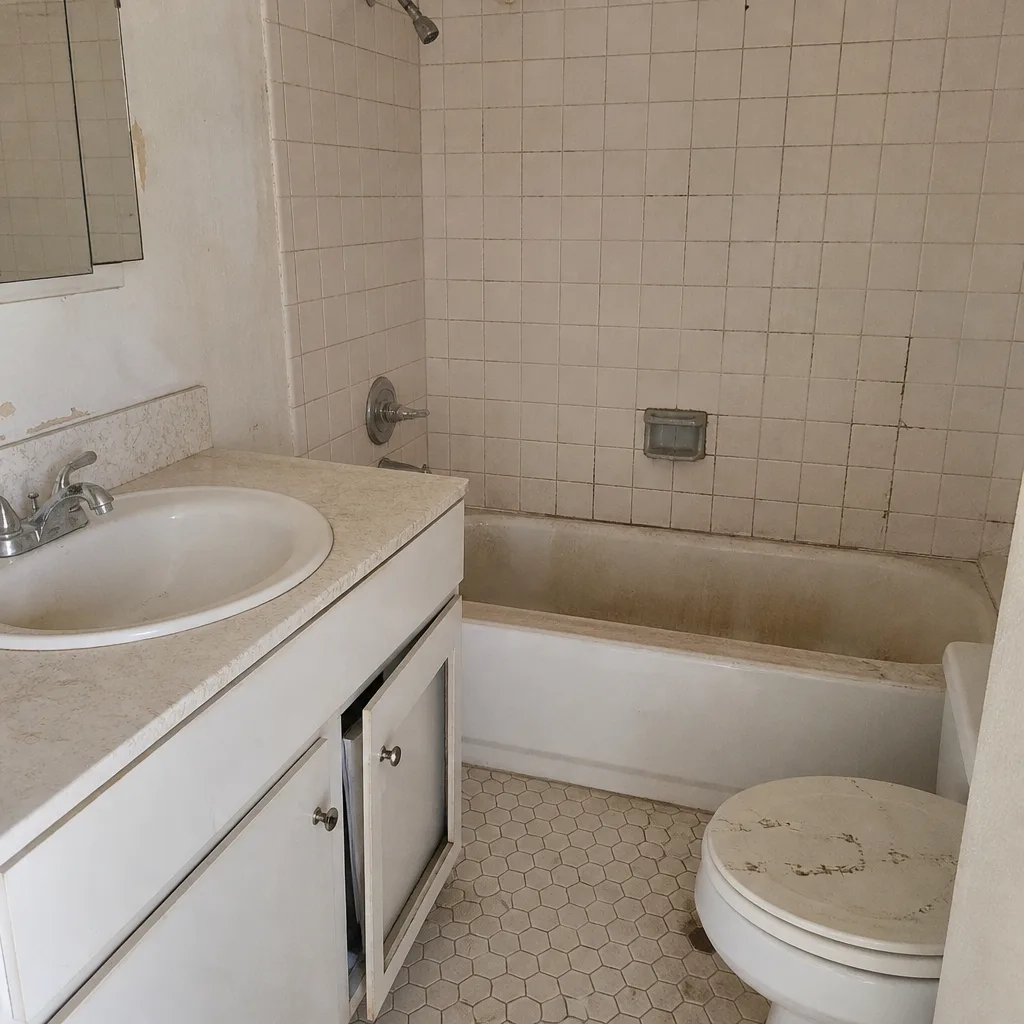 Before
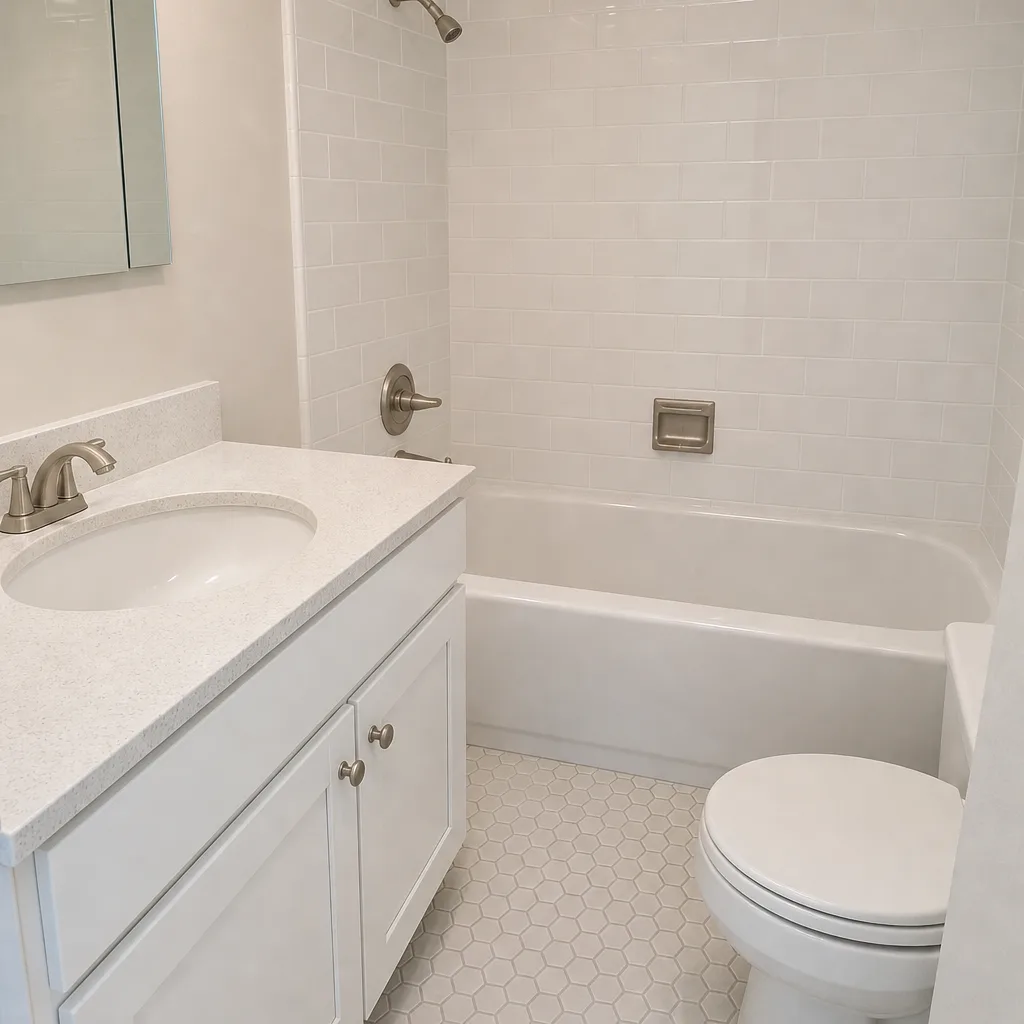 After
When to Call a Professional
Call a professional the moment any of the following is true: you’re replacing a shower pan or moving a drain, your exhaust fan terminates in the attic (that’s a moisture and mold problem waiting for the right season), you’re adding a circuit or a heated floor, your existing subfloor is soft under foot, or the bathroom sits over a slab in an older Boulder City home where drain relocations require more than surface work. These are the jobs where a bad decision costs the most and hides the longest.
Bathroom rough-in plumbing and electrical work is also the one part of the job we’d never advise a homeowner to attempt. The valves, the GFCI, the fan duct – get a licensed trade on it. Bradford Remodeling Boulder City offers free estimates in Boulder City – call (844) 797-9259, and a live person picks up, day or night.
Frequently Asked Questions
Verify the Nevada contractor license on the NSCB site and confirm the classification covers residential bathroom work; request a written scope that names the waterproofing membrane, backer board, thinset, and grout products; get the plumber’s and electrician’s names in writing; and require a payment schedule with no more than 10% down before material delivery. Our team also recommends visiting the job site during a different project so you see how the crew actually runs. Call (844) 797-9259 for a written estimate that follows this standard.
A typical full bathroom remodel in Boulder City runs roughly in the range of $18,000 to $45,000 depending on square footage, whether the drain and supply lines move, and whether the electrical panel needs an upgrade. A cosmetic refresh (tile, vanity, fixtures, paint) usually lands in the lower range, while a full gut with a drain relocation and shower system upgrade sits in the upper band. Every estimate we write is a fixed written price before work begins – call (844) 797-9259 for a real number on your bathroom.
Honestly, the homeowner can’t always tell on the first walkthrough – that’s why the written scope matters. The signal is in the follow-up question. A contractor who missed a subfloor issue and is told will revise once, in writing, with the new number attached to a specific scope item. A contractor who was baiting you will resist the revision or ask you to sign first and “sort it out later.” Insist on the written revision. Call (844) 797-9259 if you’d like to see what a fixed written price looks like on a bathroom like yours.
Permit requirements depend on the scope – a fixture-for-fixture swap may not require one, but any work that moves plumbing, adds or relocates electrical, or changes the shower footprint generally does. Ask the contractor to pull the permit in their name, not yours, and to give you the inspection record at job close. If they can’t or won’t pull the permit, that’s a warning sign that also limits your recourse if the work fails later. Our team pulls permits and passes inspections as part of the written scope.
A standard full bathroom remodel runs five to seven weeks from demo to punch, with the biggest schedule drivers being tile cure times, inspection windows, and whether a drain relocation requires opening a slab or masonry wall. A cosmetic refresh usually runs two to three weeks. Ask for the completion date in writing – we put it in the contract.
It’s a full-year written guarantee on the finished work. If a shower pan leaks, a grout line opens, a fixture fails, or the tile installation doesn’t hold inside the first twelve months, our team comes back and corrects it at no charge. It doesn’t cover damage from a homeowner’s own changes or misuse, and it doesn’t replace a manufacturer warranty on the products themselves. You get the signed guarantee in your hand at job close. Call (844) 797-9259 for the full written terms.
The Bottom Line
Bathroom remodels fail in predictable ways, and the failures are visible before you sign. The pre-quote inspection standard, the written scope with named products, the NSCB license check, the plumber’s and electrician’s names on the contract, and the payment schedule that never front-loads more than 10% – these five checks will catch the contract you don’t want. Do all five, and the remaining risk drops sharply. If you’re planning a bathroom in Boulder City and want to see what “squared away” looks like in writing, our Bathroom Remodeling in Boulder City page walks through the process and the written scope in detail. If the bathroom is part of a larger plan, our Kitchen Remodeling in Boulder City team coordinates the phases so you’re not living through two demolition zones at once.
Get Your Free Estimate

Call (844) 797-9259 to schedule your free estimate with Bradford Remodeling Boulder City. Every estimate we write is a written price before any work begins – no numbers that move at the door, no “unforeseen conditions” billed after the walls are open. You’ll work with background-checked, uniformed technicians, and every completed project carries the 365-Day Done Right Promise in writing. A live person answers the phone, day or night. Let’s get your Boulder City bathroom squared away.
Written by the team at Bradford Remodeling Boulder City.